
For industrial goods, packaging matters almost as much as the product itself. Industrial packaging that fails in transit means a damaged part, a return, delays and an unhappy customer. In this article you will find out what industrial packaging needs to provide and how to choose the right solution.
Why does proper packaging matter?
Packaging protects and preserves the goods. It also makes them easy to handle, store and identify.
These functions matter at two points:
- on delivery, when the product must reach the customer in the same condition it left in;
- in your internal flow, from the production line to the warehouse and loading bay.
The right packaging allows the goods to be transported according to the manufacturer's instructions. And the customer can be sure the goods have not lost quality on the way.
What should industrial packaging provide?
Industrial products are often heavy, bulky or sensitive. Their packaging has to meet four basic requirements.
Resistance to puncture and compression
Boxes are stacked in the warehouse and on pallets, sometimes several layers high. The packaging must carry the weight above it without deforming. Sharp edges on the parts must not pierce the walls.
Shock absorption
Knocks and accidental drops happen during handling. The packaging must absorb these mechanical impacts before they reach the product.
Protection from moisture and air
Moisture is a common risk, especially for metal parts and electronic components. The packaging must limit contact with moisture and, where needed, with air.
Sealing
The packaging must prevent the box from being opened before it reaches its destination. A seal or security tape shows straight away if the package has been opened in transit.
Which cardboard solutions are used for industrial packaging?
5-ply (double wall) corrugated board is the basis of most industrial packaging. It is strong, relatively light and can be sized to the product.
The usual solutions are:
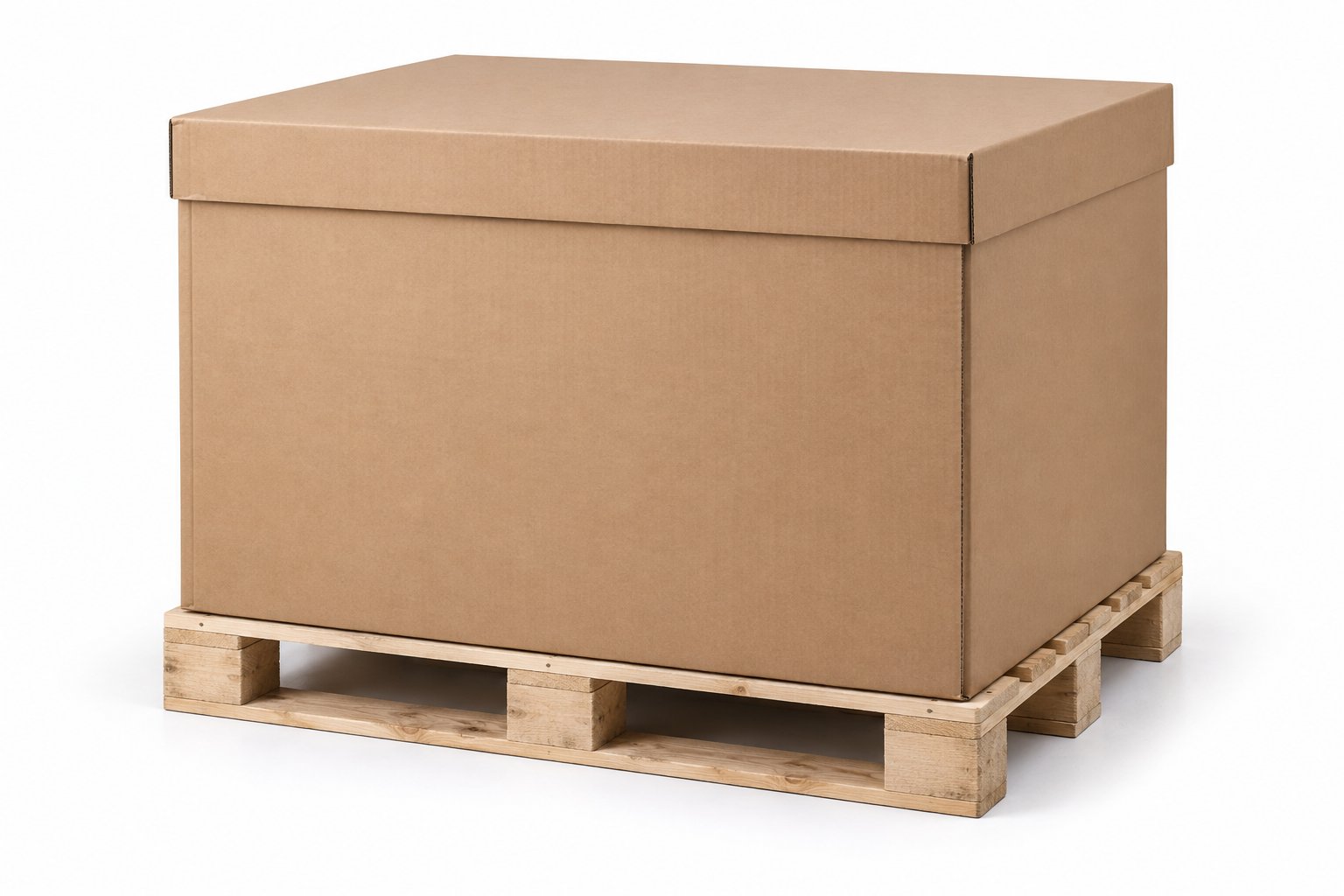
- industrial corrugated boxes and containers, for heavy or bulky parts;
- dividers and inserts, which separate the parts and stop them knocking against each other;
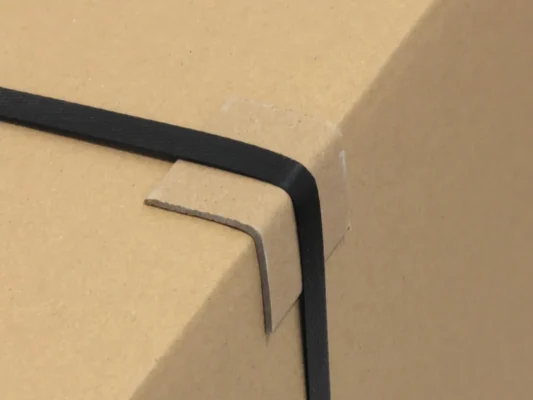
- pressed cardboard edge protectors, which protect the edges and stabilise the load on the pallet;
- export packaging kits, which combine the cardboard box, the wooden pallet and anti-corrosion VCI bags.
How do you choose packaging for industrial goods?
Start from the product and its route, not from a stock box. Answer a few questions:
- How much does one unit weigh, and what are its dimensions?
- Does it have sharp edges or surfaces that scratch easily?
- Is it sensitive to moisture or corrosion?
- How many layers are stacked in the warehouse and on the pallet?
- Is it shipped domestically or for export, and over what distance?
- How many units do you pack per month?
With this information we can propose the board grade, the box construction and the internal protection. We offer packaging design and engineering, including for products with no standard solution.
How does just-in-time delivery help?
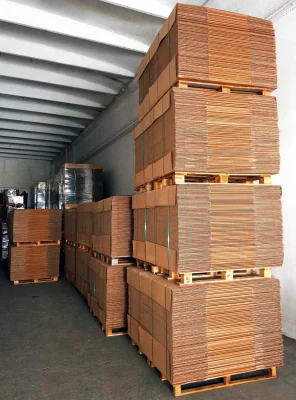
Industrial packaging takes up a lot of warehouse space. For steady flows, we offer just-in-time assembly and delivery. The packaging arrives when you need it, without large stocks for you to manage.
Our own production in Timișoara, Romania, allows us to deliver within Romania and across the European Union. Production lead time depends on the box type.
What mistakes are common when packing industrial goods?
- Under-specified board for the weight and stacking height.
- Empty space in the box, which lets the parts move.
- No edge protection, where most damage occurs.
- Ignoring moisture, especially in sea freight or long-term storage.
Conclusion
Proper packaging of industrial goods reduces damage, returns and time lost in logistics. It must withstand compression, absorb shocks, keep out moisture and stay sealed. Describe your product and its route in a quote request, and we will propose the right solution.